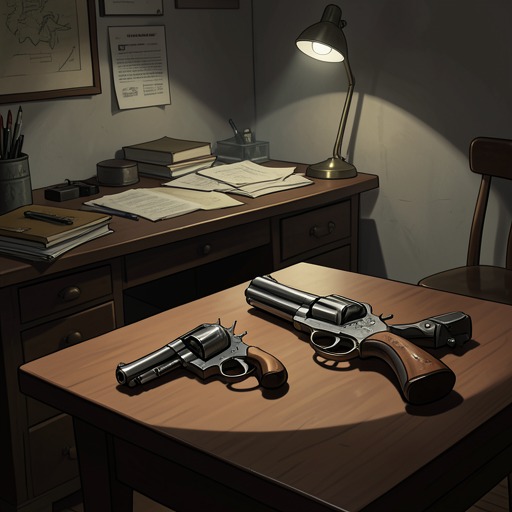
Prince Michael's revolver
The Secret of ChimneysPrince Michael's revolver is both the weapon associated with the murder of Prince Michael and a deliberately planted clue: engraved with Virginia Revel’s name, it is hidden in Herman Isaacstein’s suitcase and discovered there by Lemoine. Its movement through the investigation converts a physical object into a contested account of guilt, linking the attempt to implicate Virginia with the later effort to frame Isaacstein.
Appearance and First Interpretation
The revolver’s most conspicuous feature is the name Virginia engraved upon it. That detail makes it appear to point directly toward Virginia Revel, but the investigators find the weapon’s presentation suspicious. The Comrades of the Red Hand are known for leaving their Red Hand sign to terrorize supposed traitors; an engraved name, by contrast, seems too carefully tailored to be their usual method. The weapon therefore carries not just a possible connection to the killing but a question about who shaped the evidence and why.
One investigator suspects that King Victor intervened in the affair and deliberately tried to saddle Virginia with the murder. Yet the motive remains unclear: on the surface, there seems no particular point in bringing the accusation down on her. Anthony Cade says that he had a theory, but that it did not work out as planned. The revolver thus enters the discussion as evidence whose visible message is more certain than the purpose behind it.
Concealment in the Suitcase
Later, Lemoine searches Isaacstein’s suitcase while the others are present. He tosses aside ordinary belongings—a gold-topped bottle, silk pyjamas, and assorted socks—before noticing what appears to be a bundle of silk underwear. When he rapidly unrolls it, a heavy revolver lies inside. Bill Eversleigh gives a slight exclamation at the discovery, while Virginia Revel says that she hears the horn, making the approaching interruption part of the immediate pressure of the scene.
Lemoine repacks the suitcase with lightning speed. He wraps the revolver in his own silk handkerchief and slips it into his pocket before snapping the case shut. When the car moves on, he gives Isaacstein a cover explanation: the weapon had fallen off the luggage cart and they happened to see it. Isaacstein’s startled yellow face is glimpsed as the car sweeps away. The concealed weapon has therefore not merely been found; Lemoine removes it before Isaacstein can discover it, leaving the financier exposed to the accusation without the object in his possession.
From Discovery to Accusation
Once back with his companions, Lemoine stands holding the revolver, visibly satisfied, and calls the result a long shot that has succeeded. His satisfaction marks a change in the weapon’s function: what had been secreted among Isaacstein’s clothes is now evidence in Lemoine’s hands, obtained through a risky search and a quick deception. The suitcase discovery is not a neutral recovery of a misplaced object; it is an operation whose success depends on concealing the discovery from Isaacstein.
The consequences become explicit when Battle receives word that the revolver has been found. Anthony is surprised, but Battle identifies its location as Isaacstein’s suitcase. Anthony calls that impossible; Battle answers that nothing is impossible and admits that he ought to have remembered this possibility. He then points to Lemoine, whom the French Sûreté regards highly, and says that the discovery does not overturn his ideas. Although it initially surprises him, Battle says it fits one of his theories. The weapon’s placement appears to incriminate Isaacstein, but Battle’s response warns that its evidentiary meaning is not settled by where it was found.
The Revolver as a Manufactured Clue
The weapon’s path binds together two attempts at implication. Its engraved reference to Virginia appears designed to direct suspicion toward her, while its concealed presence in Isaacstein’s luggage supplies a different and apparently concrete accusation. These meanings do not neatly resolve into a single explanation: the earlier suspicion of King Victor’s intervention, Anthony’s abandoned theory, and Battle’s readiness to absorb the suitcase discovery into his own thinking leave the revolver’s full history open at this point.
Its material presence drives the investigation precisely because it can be made to signify more than one story. The engraving advertises a connection; the wrapping and concealment obscure custody; the suitcase location offers a new target. As the revolver passes from hidden object to discovered evidence, it exposes how the case is shaped not only by the murder but by deliberate arrangements intended to make the wrong person appear responsible.